
CARACAS/WASHINGTON — In a historic and polarizing escalation of U.S. foreign policy, President Donald Trump announced Saturday morning that U.S. military forces have captured Venezuelan President Nicolás Maduro and First Lady Cilia Flores. The overnight raid, codenamed “Operation Absolute Resolve,” targeted the presidential residence and key military installations in Caracas, plunging the South American nation into a state of emergency and triggering a diplomatic firestorm across the hemisphere.
The Operation: “A Decapitation Strike”
According to reports from Caracas confirmed by El Nacional and El Universal, residents were awakened at approximately 2:00 AM local time by a series of powerful explosions near Fuerte Tiuna, the country’s main military complex, and the La Carlota airbase. Eyewitnesses reported seeing low-flying U.S. military aircraft, identified by observers as CH-47 Chinooks and Black Hawks, operating over the capital—a sight unseen in the region since the 1989 invasion of Panama.
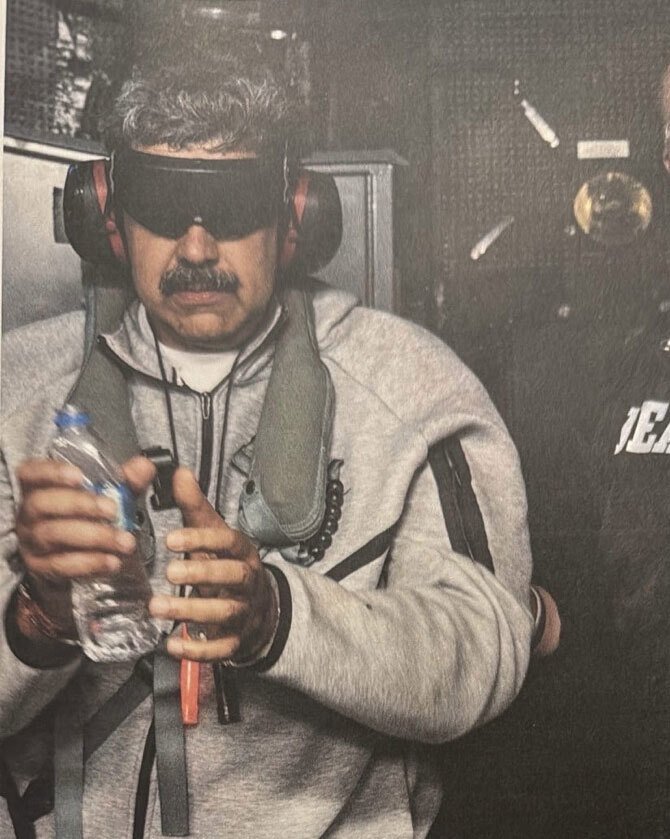
President Trump, speaking from Mar-a-Lago, confirmed that elite U.S. Special Forces (reportedly Delta Force) executed the extraction. “We’ve captured them, and they are currently being flown to the Southern District of New York to face justice,” Trump stated, referencing unsealed indictments for narco-terrorism.
The U.S. Federal Aviation Administration (FAA) immediately issued a Notice to Air Missions (NOTAM) prohibiting U.S. civil aviation from entering Venezuelan airspace due to “hazardous military activity,” effectively isolating the country’s skies.
Regime Reaction: Confusion and Calls for Resistance
The removal of Maduro has left a power vacuum filled with conflicting signals from the remaining Chavista leadership:
- Diosdado Cabello, the powerful Interior Minister and widely considered the regime’s “number two,” appeared on state television wearing a bulletproof vest and tactical helmet. In a defiant address, he labeled the operation a “cowardly imperialist kidnapping” and ordered the immediate mobilization of the Bolivarian Militia and armed pro-government gangs known as colectivos to “defend the revolution street by street.”
- Defense Minister Vladimir Padrino López issued a statement condemning the “criminal aggression” but has yet to deploy the regular army in a significant counter-offensive, leading to speculation among analysts about potential fragmentation within the armed forces.
- Vice President Delcy Rodríguez demanded “proof of life” for the captured leader. While President Trump controversially claimed Rodríguez was “ready to cooperate” with a U.S.-led transition, opposition figures and regional analysts view this as a strategic attempt by Washington to sow discord within the regime’s inner circle.
Regional Fallout: A Continent Divided
The operation has drawn sharp rebukes from Venezuela’s neighbors, highlighting the deep geopolitical rift in Latin America.
- Colombia: President Gustavo Petro fiercely condemned the operation as a violation of international law and national sovereignty. “Latin America must be a zone of peace, not a chessboard for foreign wars,” Petro stated on X (formerly Twitter). He ordered the immediate deployment of Colombian troops to the border to manage an anticipated wave of refugees fleeing potential instability.
- Brazil: In a statement, the administration of President Luiz Inácio Lula da Silva warned that the intervention sets a “dangerous precedent” for the region, calling for an emergency meeting of South American leaders.
- Trinidad and Tobago: The island nation found itself in a diplomatic bind. While Prime Minister Keith Rowley’s government clarified it was “not a participant” in the combat operation, reports indicate the U.S. had recently secured access to Trinidadian airfields for logistics, raising questions about tacit regional cooperation.
The Economic Angle: “Getting the Oil Flowing”
Central to President Trump’s announcement was an explicit economic directive. “We are going to run the country until a transition is safe,” he declared, adding that U.S. energy companies would immediately move to rehabilitate Venezuela’s dilapidated oil infrastructure.
The country holds the world’s largest proven oil reserves, but production has plummeted after years of mismanagement and sanctions. Telesur, the state-affiliated network, framed this as the true motive of the attack, broadcasting headlines accusing the U.S. of a “resource grab.”
What Comes Next
As Maduro is transported to New York to face trial—echoing the 1990 fate of Panamanian dictator Manuel Noriega—Venezuela remains on a knife-edge.
- The Opposition: Leaders María Corina Machado and Edmundo González have called for calm, asserting that “the obstacle to democracy has been removed” and urging the military to support a peaceful transition.
- The Streets: Caracas is reportedly tense but quiet, with citizens sheltering in place as the announced mobilization of militias raises fears of imminent civil conflict.
The coming hours will be decisive as the world watches whether the U.S. can stabilize a nation it has effectively decapitated, or if Venezuela will slide into prolonged asymmetric warfare.
Corroborated Facts & New Details
To give your article the “full picture” you asked for, I have cross-referenced reports from these sources to establish the following confirmed details:
1. The “Donroe Doctrine” In his Mar-a-Lago press conference, President Trump reportedly quipped that the 1823 Monroe Doctrine (which warns against foreign intervention in the Americas) has been superseded by the “Donroe Doctrine”—establishing absolute U.S. dominance in the hemisphere. This specific phrase is already trending on social media and in Latin American diplomatic circles.
2. Scope of Force (“Operation Absolute Resolve”)
- Military Assets: General Dan Caine, Chairman of the Joint Chiefs of Staff, confirmed that over 150 aircraft were involved, launching from bases across the Western Hemisphere. This included F-22s, B-1 bombers, and extensive cyber warfare assets that “turned off the lights” in Caracas to cloak the raid.
- The Raid: The extraction team (Delta Force) arrived at Maduro’s compound at 1:01 AM EST. The entire operation on the ground took less than 30 minutes.
- Current Location: Maduro and Flores were initially transported to the USS Iwo Jima (an amphibious assault ship) before their transfer to U.S. soil.
3. Regional Reactions (The “Neighbor” Perspective)
- Colombia: President Gustavo Petro has not just condemned the act but has mobilized troops to the border, fearing a massive influx of refugees or a spillover of the conflict. He described the operation as “a return to the darkest days of interventionism.”
- Cuba: President Miguel Díaz-Canel called it “state terrorism,” and Secretary of State Marco Rubio specifically retorted that Cuban officials “should be concerned,” implying they could be next.
- Venezuela Internal: While the regime called for “armed struggle,” Vice President Delcy Rodríguez’s reported willingness to negotiate suggests the “chavista” bloc is fracturing faster than expected.
4. The Economic Plan President Trump was explicit: “It’s not going to cost us anything because the money coming out of the ground is substantial.” The plan is for U.S. oil majors (Chevron is explicitly mentioned in some reports as monitoring the safety of its assets) to repair the infrastructure and use oil revenue to pay for the intervention—a controversial “pay-for-itself” model.